
SUNNY SKIES AND A STEADY WARMUP THROUGH FRIDAY
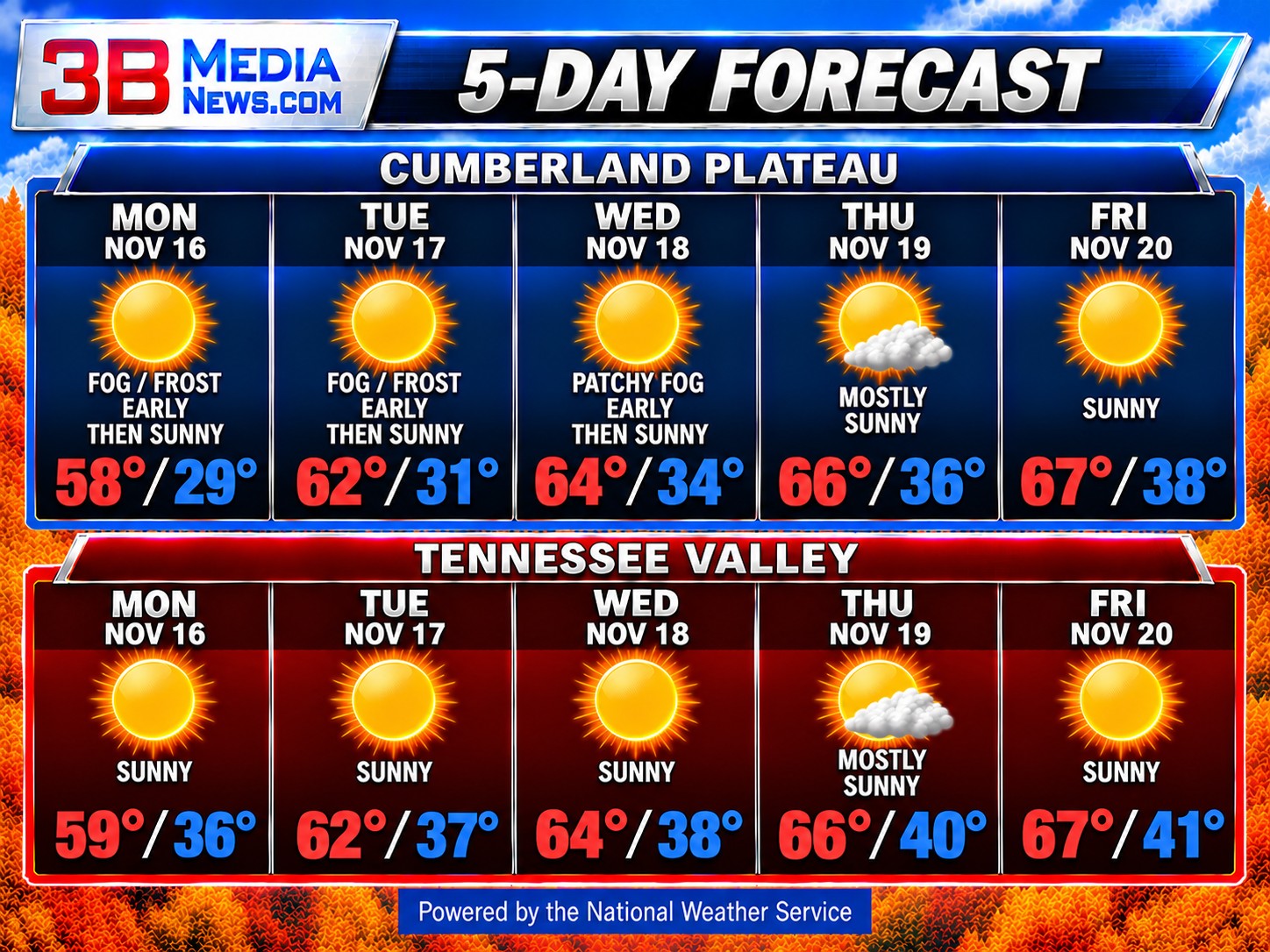
A stretch of sunny and dry weather continues across the Cumberland Plateau and Tennessee Valley this week, with temperatures gradually warming each afternoon. Monday begins with widespread frost and patchy fog on the Cumberland Plateau, but sunshine will quickly take over. Highs will reach the upper 50s across both regions, with light winds throughout the day.
Monday night turns cold again, especially on the Cumberland Plateau, where lows fall to around 29 with widespread frost developing after midnight. The Tennessee Valley will be clear and chilly, with lows in the middle 30s. Tuesday brings another sunny day, with highs around 62 in both regions. Areas of morning fog and frost will remain possible on the plateau.
The warming trend continues Wednesday and Thursday. Highs climb into the middle 60s across both regions, with plenty of sunshine and generally light winds. Overnight temperatures also begin moderating, although the Cumberland Plateau will continue to experience colder nights than the Tennessee Valley.
Friday looks like the warmest day of the week, with sunny skies and highs near 67 across both regions. Friday night lows will settle into the upper 30s on the Cumberland Plateau and lower 40s in the Tennessee Valley. No rain is expected through Friday, making this an unusually quiet stretch of November weather.
CLIMATE & ALMANAC
Normal High: 56°
Normal Low: 35°
Record High: 73° — 1971
Record Low: 20° — 1995, 2011
Record Rainfall: 2.57 inches — 1957
Sunrise: 6:18 AM CST
Sunset: 4:32 PM CST
Daylight: 10 hours, 14 minutes
Daylight is decreasing by approximately one minute and 38 seconds each day.
SKY & SEASONS
Moon: Waxing Crescent, approximately 39% illuminated
Next Full Moon: Tuesday, November 24 at 8:53 AM CST
Next New Moon: Tuesday, December 8 at 6:51 PM CST
Next Season Change: Winter begins Monday, December 21.
Daylight Saving Time: Returns Sunday, March 14, 2027. Clocks move forward one hour at 2:00 AM.
Forecast information provided by the National Weather Service. Climate information is based on National Weather Service and NOAA records. Astronomical information is based on established astronomical calculations.