
TN TECH ENGINEERING STUDENTS BUILD ALL-TERRAIN WHEELCHAIR
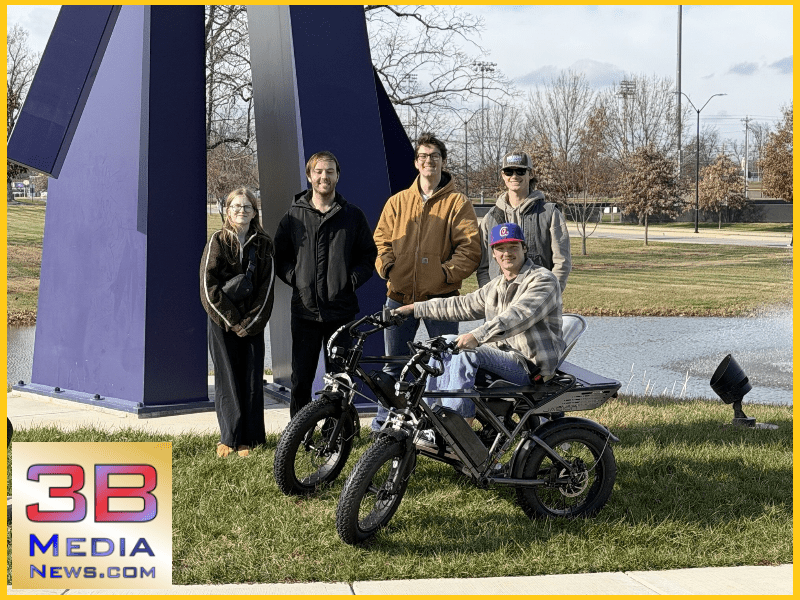
A team of Tennessee Tech University engineering students is helping a local community college student get back to the activities he once enjoyed with a custom-built all-terrain wheelchair.
Michael Vhan McGuire, an architecture student at Nashville State Community College, loves the outdoors. But navigating natural terrain has been difficult since he was paralyzed from the waist down in a 2024 motorcycle accident.
That is, until a team of engineering students in Professor Stephen Canfield’s kinematics and dynamics of machinery course at Tech stepped in.
“They worked closely with Vhan to select a preferred design, then moved into detailed engineering analysis, fabrication and testing, which resulted in a great final product,” said Canfield.
For more than 25 years, his course has challenged students to turn theory into practice with Tech Engineering for Kids, which has produced hundreds of custom-designed devices to meet the special needs of families in Middle Tennessee.
While most projects serve children with special needs, this semester offered a rare peer-to-peer collaboration — something students said made the experience especially meaningful.
“It was easy working with someone our own age,” said student John Avery. “Vhan knew what he wanted, what features he needed, and he could explain these things clearly to us.”
The peer-to-peer relationship made it especially easy for the engineering students to work closely with McGuire, whose involvement they say helped streamline the decision-making and allowed them to move quickly from concept to construction. McGuire even made several trips to Tech throughout the two-month design phase and month-long building process.
Canfield said he noticed that the team connected with McGuire quickly, on the first day of class, and immediately began brainstorming solutions that would allow him to better participate in outdoor activities.
“Their early designs integrated electric mountain bikes in various configurations, playing with aspects like suspension, steering, drive systems and accessibility,” Canfield said.
Early in the semester, the team researched existing all-terrain wheelchair models, including a popular concept known as “The Rig.” While the design provided inspiration, students determined it would require more fabrication work — including extensive welding, motor construction and drivetrain assembly — than could realistically be completed in a single semester.
Instead, the team settled on a design that adapted two motorized mountain bikes into a wheelchair configuration inspired by the same blogger who created The Rig. By using existing bike motors and components, students were able to focus on customization, safety and usability without starting entirely from scratch.
“This was the first class where we really took theories from previous courses and put them into practice. It was the first time everything felt fully hands-on,” Avery said.
For fellow team member Christa Irby, the project provided both technical growth and a deeper personal lesson.
“I wanted to learn more about using the tools and being in the workshop,” Irby said. “But the project also taught me how to view the world from another person’s perspective — both personally and professionally.”
That perspective, she said, was sharpened by designing for a peer.
“We were so immersed in the project that we had no choice but to put ourselves in Vhan’s shoes,” Irby said. “Most of us don’t often think about what it’s like to have a body that’s abled differently, but that’s what this project was all about – giving him something that was safe, useful and purposeful.”
Both Avery and Irby said they and their fellow teammates learned from the experience what an impact hands-on engineering can have – not just in building technical skills, but in fostering empathy and a clearer understanding of how design choices directly affect real people.
For McGuire, it was always about more than coursework. The team’s creation, he said, “gives me back my legs.”
“I want to give a huge shoutout to the team that helped make this possible. I’m very blessed and fortunate to have worked with them on this,” he said.
A self-described outdoors enthusiast who loves hiking, McGuire said he had been limited in the activities he could safely pursue after his accident.
“A regular wheelchair struggles on any surface that isn’t hard and flat,” he said. “Now, having a piece of equipment that can go anywhere — and that I feel comfortable with— is a blessing. This gets me back to what I loved doing and how I loved living before my accident. So, a huge thank you for this amazing opportunity.”
For more information about the project, including design specification and student reflections, click here.